Yes—you can grill on a Traeger because its pellet‑fed, digitally controlled system delivers steady, adjustable heat for both direct searing and indirect low‑and‑slow cooking. The auger feeds pellets automatically while the controller matches feed rate to your set temperature, and sealed hopper seals keep moisture out. WiFIRE, D2, and Smart Combustion let you fine‑tune temperature, smoke, and keep‑warm functions from an app. If you keep going, you’ll uncover how to optimize pre‑heat, choose heat modes, and troubleshoot common issues.
How a Traeger Eats Pellets & Keeps Heat Steady
When you load pellets into the hopper, the auger automatically feeds them into the firepot, and the digital controller adjusts the feed rate to match the selected temperature. The auger runs continuously, pulling pellets at a rate proportional to the set point, which yields efficient pellet consumption. A sealed hopper cover blocks moisture, preventing sawdust formation that could jam the auger. The pellet sensor alerts you via the app when levels dip, so you can swap bags without interrupting the cycle. Double‑walled insulation and precision‑fitted lid gaskets maintain steady temperature control, even when ambient conditions fluctuate. Pure hardwood pellets combust at 99 % efficiency, producing minimal ash and keeping the firepot hot enough for low‑smoke (≈1 lb/hr) or high‑heat (≈2 lb/hr) cooking phases. Traeger grills offer a convection system that ensures even heat distribution across the cooking chamber. This versatility allows you to accommodate a wide range of cooking styles—from low‑and‑slow smoking to high‑heat searing—enabling you to experiment with meats, vegetables, and other foods while maintaining precise temperature control.
Set Up Your Traeger Grill for Perfect Pre‑heat
Before you fire up your Traeger, make sure the hopper is fully loaded with clean pellets, the temperature probe is scrubbed free of dust and grease, and the porcelain grill, grease pan, and heat baffle are all correctly positioned; also verify a minimum 12‑inch clearance from any combustible material. Load the hopper to optimal maximum capacity; a full hopper guarantees sustained burn for longer cooks. Open the lid, set the selection dial to the desired temperature, and press the ignite button. Watch the controller’s animated arrow and note the 5‑degree temperature increments—these are your preheat monitoring tactics. For newer models with touchscreen WiFIRE controllers, press and hold the ignite button to ensure proper startup. Allow the grill to stabilize for 10‑15 minutes (or 30‑45 minutes on larger Woodridge models) before closing the lid and adding food. This sequence guarantees consistent pre‑heat and minimizes temperature drift. Correct ignition prevents flame‑outs and temperature swings.
Master Temperature With Wifire, D2 & Smart Combustion
After the grill reaches a stable pre‑heat, you can lock in precise temperature control with WiFIRE, the D2 controller, and Smart Combustion. WiFIRE links the grill to the Traeger App, streaming internal and probe temperatures for remote temperature monitoring. The D2 display lets you set the target directly, engage Super Smoke, or activate Keep Warm at 165 °F without leaving the grill. Smart Combustion automatically adjusts pellet feed and fan speed, maintaining the set point and reducing temperature trouble shooting. You can add pellets, tweak the temperature, or switch smoke levels from your phone or Apple Watch. The app mirrors controller timers, notifies when pre‑heat ends, and guides you through GrillGuide cycles, ensuring consistent, expert‑level results. Wifire also provides access to over 1,600 recipes directly from the app. Traeger manufactures its grills in China and Vietnam, though the company continues to produce all-natural wood pellets domestically across multiple USA facilities.

The Universal WiFI Controller replacement is compatible with Traeger D2 Direct Drive Pellet grills Smoker Ironwood 650,Ironwood 885,Pro 575 Pro 780,Timberline 850 ,Timberline 1300,Silverton 620,Silverton 810.This Wifi control board is designed to directly replace the following Traeger D2 WiFIRE controllers: KIT0391 (Ironwood 650), KIT0400 (Ironwood 885), KIT0402 (Pro 575), KIT0410 (Pro 780 Direct Drive), KIT0478 (Timberline 1300), KIT0486 (Timberline 850), KIT0530 (Silverton 620), and KIT0542 (Silverton 810).
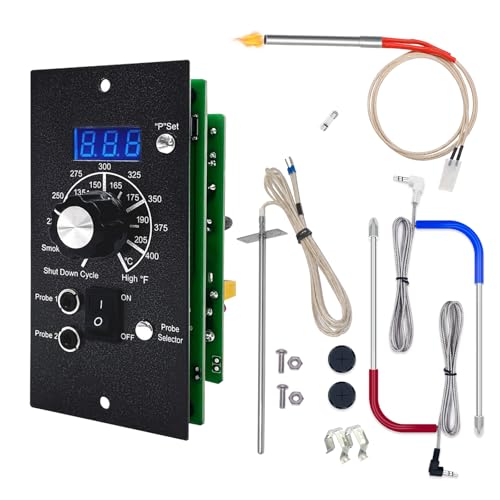
Compatibility: ✔ Direct replacement for Traeger models: Pro 20, 22, & 34, Texas Elite 34, Lil Tex 22, Junior Elite 20, Ridgeland, Heartland, Mesa 22, Century 22/34, Silverton (2019) (Compatible with BAC365/BAC236 systems). ✖ Excludes: Junior, Tailgater, Bronson grills.

The WiFi Controller is compatible with Traeger D2 Direct Drive Pellet Grills Smoker Ironwood 650,Ironwood 885,Pro 575 Pro 780,Timberline 850 ,Timberline 1300,Silverton 620,Silverton 810.Traeger Replacement For Part Number:KIT0402, KIT0410, KIT0391, KIT0400, KIT0478, KIT0486, KIT0530, KIT0542.
Choose Direct vs. Indirect Heat on a Traeger
Choosing between direct and indirect heat on a Traeger hinges on temperature range and food type. Direct heat runs 450‑500°F, delivering rapid Maillard browning for thin cuts like burgers, steaks, and fish. You must monitor cooking time closely and turn items to avoid burning. Indirect heat operates 250‑400°F, using convection and radiant heat to cook large roasts, whole poultry, and delicate proteins evenly. This mode lets you control smoke intensity, infusing flavor without charring. Adjust the pellet‑board temperature instead of creating zones; the whole grill becomes a uniform cooking surface. Use direct heat for quick sears, indirect for low‑and‑slow tenderness, and switch seamlessly by resetting the temperature. Before your first cook, properly season the grill before first use to burn off manufacturing residues and ensure optimal performance. Season the meat before grilling for maximum flavor penetration.

Broad Compatibility:Compatible with Traeger Tex Elite and Tex Fits 2007 newer Tex, Lil Tex, Elite Tex Elite Traeger Pro 34 Series,Traeger Pro 22 Series, Century 22, Eastwood 22, Eastwood 34,Z Grill,Camp Chef and More.Heat Baffle Diffuser Replacement Parts for Z Grill, Camp Chef, Pit Boss Series Pellet Grills(NOT ALL)

Season your Traeger Flatrock or other favorite cast iron cookware for a non-stick cooking surface

Expand Your Grilling Space with a Folding Shelf – The Traeger folding front shelf adds extra workspace to your grill, perfect for prepping food, holding beverages, or placing BBQ utensils.
Pick the Best Foods for Each Traeger Heat Mode
Most Traeger users can match foods to the three primary heat zones—high (400‑500°F), medium (300‑400°F), and low‑and‑slow (below 300°F)—to maximize flavor and texture. In the high zone, you’ll want lean quick‑cooking proteins: chicken pieces, salmon fillets, and thick steaks. Aim for preferred grill roast temperatures for meats, searing the exterior while locking juices; finish steaks at 130 °F internal before they rest to 135 °F. Zucchini spears and artichokes char directly on the lowest grate. Medium heat suits cauliflower florets and baked meatballs; the zone provides excellent smoke exposure for healthy sides and lets chicken leg quarters absorb rubs without drying. For chicken quarters specifically, monitor the internal meat temperature to reach 175°F for juicy dark meat rather than relying solely on time. Low‑and‑slow is reserved for tri‑tip, pulled pork, brisket, and chicken breast, where extended smoke builds bark, tenderness, and protein‑rich results. The Traeger Smoked Chicken Breast provides 31 g of protein with only 165 calories, making it an ideal lean protein for the high‑heat zone.
Fix Common Traeger Grill Issues (Temp, Pellets, Smoke)
Ever notice your Traeger stalling at the set temperature, sputtering out pellets, or producing thin smoke? First, verify pellet quality and moisture; low‑grade pellets cause weak burns and erratic feed. Clean the firebox and chimney of sawdust; blockage raises temperature spikes and thins smoke. Check the induction fan spins on ignition—if it stalls, open the hopper panel, secure the Molex connectors, and reinstall the fan. Use a third‑party thermometer to confirm the controller’s reading; a 50°F discrepancy signals a faulty RTD probe or controller. To diagnose controller problems, unplug, remove the two mounting screws, detach the auger motor, and swap the board, ensuring zip‑tied wires stay clear. Finally, update Wi‑Fi firmware to apply the 2016 Digital Pro fix, which stabilizes temperature and smoke output. Regular cleaning schedules prevent grease buildup that can interfere with temperature regulation and component performance. Secure the four Molex connectors before reinstalling the fan.
Clean & Maintain Your Traeger Grill Quickly
When you finish a cook, quickly wipe down spills and scrape the grates before they harden, because a fast pre‑cook clean prevents buildup that later forces a deep‑clean cycle. Remove the grates, dump debris into the grease keg, and empty the drip‑tray liner. Use a plastic putty knife or wooden spatula for scraping, then vacuum ash and sawdust from the firepot, hopper, and auger with a shop vacuum. Spray the interior, chimney, and walls with Traeger All‑Natural Cleaner; let it soak, then wipe with heavy‑duty paper towels. Perform efficient exterior cleaning every three months or after heavy use—wipe the shell with disinfectant wipes and check the temperature probe. Finally, execute routine pellet hopper maintenance: inspect for moisture, wipe dry, and refill with fresh pellets before the next cook. Regular cleaning is essential for extending the life of your grill.
Compare Traeger Models & Choose the Right One for You
Choosing the right Traeger starts with matching your cooking volume, connectivity needs, and budget to the model’s core specs. If you need 860‑970 sq in. and WiFIRE control, the Woodridge line fits entry‑level budgets; the Pro adds Super Smoke, while the Elite includes premium features and 24‑lb hopper capacity. For mid‑range, the Ironwood 650 or 885 offers porcelain‑coated grates, downdraft exhaust, and 20‑lb hoppers, delivering consistent temperature for a reliable winter grilling experience. The Timberline XL tops the range with 1,320 sq in., three racks, 24‑lb hopper, built‑in pellet sensor, and four meat probes—ideal for large crews and extended sessions. Compact options like Tailgater 20 or Ranger lack WiFIRE but provide portable power. Review warranty coverage for each tier to guarantee long‑term support. Like traditional gas grills, Traeger models prioritize temperature control to ensure even heat distribution across the cooking surface. All Traeger models deliver high heat for optimal cooking results.

Compatibility: Replacement WiFIRE Controller Parts compatible with Traeger D2 Direct Drive Pellet Grills Smoker Pro 575 & 780, Ironwood 650 & 885, Silverton 620 & 810, Timberline 850 &1300 (Gen 2 only), Century 885. Replacement Parts: KIT0402, KIT0410, KIT0391, KIT0400, KIT0478, KIT0486, KIT0530, KIT0542. NOTE: This Control Board Without Pellet Sensor Interface.

This Wifire controller is designed to directly replace the following Traeger D2 WiFIRE controllers: KIT0391 (Ironwood 650), KIT0400 (Ironwood 885), KIT0402 (Pro 575), KIT0410 (Pro 780 Direct Drive), KIT0478 (Timberline 1300), KIT0486 (Timberline 850), KIT0530 (Silverton 620), and KIT0542 (Silverton 810). Standard thermocouple only. NOTE: The controller Without Pellet Sensor Interface.

WIDE COMPATIBILITY: The control panel can fit a wide range grill models of Traeger , Pit Boss, Z grills and Asmoke. See picture for specific model.