Set your grill for indirect heat by arranging coals around the perimeter and closing the lid to create an oven‑like environment at 325 °F, then coat the turkey’s skin with a butter‑olive‑oil rub and stuff it with a moist breadcrumb‑sausage blend. Place the bird in the center, monitor vents to keep a steady temperature, and baste every 30 minutes while rotating it for even crisping. Cook 10‑13 minutes per pound until the thigh hits 160‑162 °F, then let it rest 30‑60 minutes before carving; more details await.
Set Up Indirect Heat for Grilling a Turkey
Set up indirect heat by arranging the coals around the grill’s outer edge or on one side, then place the turkey in the center where it’s away from direct flame. When you’re choosing coals placement, make sure the fire ring is uniform to prevent hot spots. Close the lid tightly; this traps heat and creates an oven‑like environment. Aim for a consistent 325‑350 °F zone, using a grill thermometer to monitor the internal air. Adjust vents or add a few coals to maintain low temperature without spikes. Position a drip pan beneath the bird to collect juices and add water for moisture. Keep the lid closed except for brief checks, and rely on a meat thermometer to verify breast and thigh temperatures, ensuring even, juicy cooking. Using a meat thermometer to check internal temperatures—aiming for 165°F in the breast—ensures the turkey reaches the safe temperature required for consumption. This method ensures even cooking without scorching the exterior.
Season & Stuff Your Turkey Before Grilling
Once the turkey’s brine is removed and it’s thoroughly patted dry, you can lock in flavor by coating the skin with a generous rub—whether it’s Honey Hog, Cajun Creole Garlic Butter, or another favorite blend—and then preparing a moist stuffing that will keep the meat juicy while it grills.
Begin your Marinade preparation by mixing melted butter, olive oil, and a pinch of salt and pepper; brush this onto the rub‑coated skin to enhance adhesion. For the stuffing, dice carrots, celery, onions, and mushrooms, then sauté them in butter for five minutes until tender. Combine the sautéed vegetables with pre‑cooked sausage, toasted French‑bread cubes, and a half‑cup chicken broth plus half a cup water. Stir until the mixture reaches a cohesive, moist Stuffing consistency, then spoon it into a greased 13 × 9‑inch pan, covering with foil before grilling. Using a meat thermometer is essential to verify that your turkey has reached the safe internal temperature throughout cooking.
Smoke the turkey at 275°F for 3‑3.5 hours to ensure even cooking and juicy meat.
Calculate Cook Time & Internal Temp for a Grilled Turkey
After the rub and stuffing are in place, focus on the grill’s temperature and the turkey’s cooking timeline. Set the grill to a steady 325°F and preheat for 10–15 minutes, then place the bird on indirect heat. Calculate cook time as 10–13 minutes per pound; a 12‑lb turkey will need roughly 2 hours – 2 ½ hours. Every 30 minutes, monitor grill temperature and measure internal temperatures. Insert an instant‑read thermometer into the thickest breast, avoiding bone, and also probe the innermost thigh and wing. Aim for 160–162°F in the thigh; carryover will bring it to the USDA‑required 165°F throughout the meat and stuffing. Remove the turkey, cover with foil, and let it rest 15–30 minutes, allowing temperature to rise an additional 5–10°F. A 165°F temperature ensures the destruction of harmful bacteria. For extra browning and texture, consider raising your grill temperature to 375-400°F for 10-15 minutes near the end of cooking to crisp the skin.
Control Grill Heat & Vents While Grilling
You’ll find that mastering the grill’s vents is the key to keeping a turkey at a steady 325‑450 °F. Start with both bottom and top vents fully open to ignite the fire, then close the bottom intake to half‑inch or quarter‑inch, depending on your grill model, while keeping the top vent roughly halfway open. This balance creates a chimney effect that stabilizes heat without constant lid adjustments. For a Weber Kettle, set the bottom vent quarter‑inch and the lid vent halfway; on a Kamado, use the Kontrol Tower top vent to fine‑tune airflow. Perform vent adjustments incrementally—each small change shifts temperature by 10‑15 °F. Monitor the gauge, keep airflow smooth, and maintain consistent temperature control throughout the roast. One‑sided indirect heat helps the turkey cook evenly without drying out.

PREMIUM STAINLESS-STEEL CONSTRUCTION - Crafted from top-grade stainless steel, our adjustable smoker vent are meticulously constructed to offer exceptional durability and resistance to corrosion, ensuring unparalleled performance that lasts.

Adjustable wall/ceiling register: The 12x6 register vent cover fits 12”W X6”H duct opening.Actual cover outer size:13.75"W X 7.75"H.Pls make sure the size of wall/ceiling duct opening/hole is 12"W x 6"H

GENEROUS SIZE - 48" steel baseboard air vent cover and register grille in brown color, ensuring expansive coverage for efficient air supply in larger spaces.
Baste & Rotate the Turkey for Even Grilling
Mastering basting and rotation keeps the turkey moist and cooks it evenly across the grill’s hot spots. Begin basting after the first browning, then repeat at the two‑hour mark. From the first hour onward, baste every 30 minutes using olive oil or chicken stock, pouring accumulated juices into the pan to build a gravy base. Tilt the bird while the lid is open for easy collection. Rotate the turkey 90° every 30 minutes; flip it breast‑down for a brief period to expose the thickest part to direct heat. Use a two‑zone setup or a rotisserie spit to balance coals. Continuously monitor browning and internal temperature, aiming for 160‑165 °F in the breast and 175 °F in dark meat, to maximize moisture absorption and guarantee uniform cooking. After grilling completes, allow the turkey to rest for 10-15 minutes before carving so that juices redistribute throughout the meat for optimal tenderness. Set up the grill with a two‑zone arrangement so you can control indirect heat for the turkey’s larger sections.
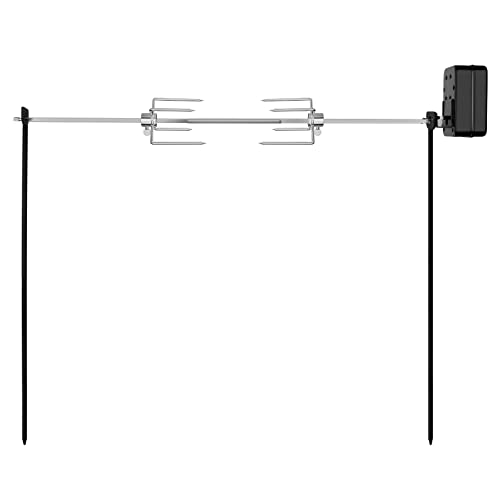
【Dimensions】Measures about 36.5"W×27.8"H. Durable steel support system allows for easy and sturdy set-up.

【Dual Power Motorized Rotisserie Spit Kit – Perfect For Camping Campfire Cooking】This outdoor electric rotisserie spit kit comes with a powerful automatic rotating motor, supporting two power supply modes: D batteries or DC power cord (accessories not included). Slow even rotation makes whole chicken, lamb, and roast meat evenly cooked, ideal for campfire, RV camping, backyard open fire cookouts.

Rest the Turkey Before Carving After Grilling
If you let the turkey rest for 30 minutes to an hour before carving, the juices will redistribute evenly, keeping the meat moist while the skin stays crisp; this window offers the ideal balance between safety and flavor. Place the bird on a clean board, reveal it, and let the internal temperature stabilize. An extended rest duration beyond one hour risks bacterial growth and softens the crust into a rubbery texture, so avoid tenting or covering. While it rests, prepare a sharp chef’s knife and a towel‑damped cloth to grip the breast. The turkey is safe to eat when the internal temperature reaches 165°F in the thickest part of the breast and 180°F in the thigh. When the timer expires, carve the thigh skin at an angle, then slice the breast, preserving a balanced skin texture that remains crisp yet tender. No need to rest for longer than an hour, as the consensus among chefs is that immediate carving preserves crispness.
Fix Dry Meat & Smoke Issues When Grilling a Turkey
After the turkey has rested, the next priority is preventing the meat from drying out and controlling smoke for a clean flavor. Begin by dry‑brining 1–3 days ahead, patting the bird dry before rubbing salt, garlic powder, and mashed butter. This combo maximizes moisture retention and creates a barrier that helps prevent skin browning. Set the grill for indirect heat: arrange a U‑shaped bank of lump charcoal on one side, keep the temperature around 350°F, and place the turkey breast‑side up after the first hour. Insert butter pats under the skin and in breast pockets, and dip sliced meat in pan juices immediately after cutting. Soak wood chunks, add them to the cooler side for two hours, and catch drippings in a pan to further control smoke and preserve juiciness. Just as with smoking brisket, internal temperature should guide when to remove the turkey from the grill. Add ice packs to the breast to keep it cooler while the legs warm up.