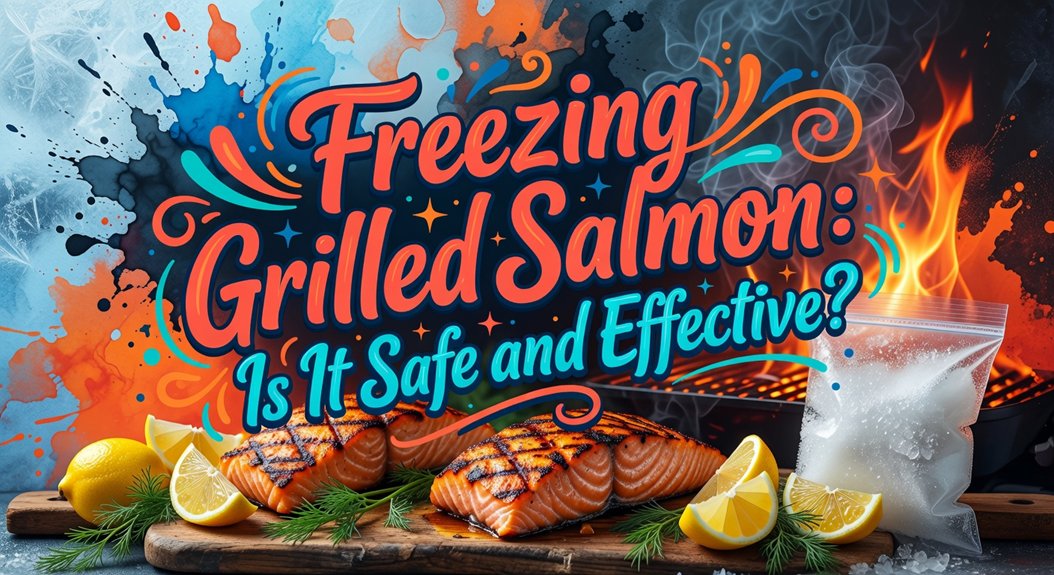
You can safely freeze grilled salmon by flash‑freezing it at ‑10 °F (‑23 °C) or colder, which instantly stops bacterial growth, locks the fish below the danger zone, and destroys parasites. Double‑wrap each portion in plastic and foil, expel all air, then store it at 0 °F (‑18 °C) or lower in a deep freezer; this keeps texture, flavor, and oxidative stability intact. Proper thawing in the refrigerator and reheating to 130‑145 °F preserves safety and quality, and the next sections will show you exactly how.
Why Freezing Grilled Salmon Is Safe
Because freezing immediately halts bacterial growth after grilling, you can safely store grilled salmon without risking the rapid multiplication that occurs between 40 °F and 140 °F. Freezing temperature control locks the fish below the danger zone, preventing pathogens from proliferating. Evidence shows that solid ice formed within hours post‑cooking eliminates growth, while flash freezing at –10 °F or lower also destroys parasites, satisfying FDA recommendations for raw‑fish safety. Maintaining a consistent sub‑zero environment curtails lipid oxidation, preserving PUFA integrity and texture. When you later apply proper thawing techniques—slow refrigeration at 35‑40 °F or sealed‑bag immersion in cold water—you keep the product within safe limits, ensuring the grilled salmon remains microbiologically sound and nutritionally stable. For best results, freeze your salmon after it has reached an internal temperature of 125 °F to 130 °F and cooled slightly to room temperature.
Freeze Grilled Salmon Properly for Flavor & Texture
Preservation hinges on controlling moisture and air exposure, so you should portion grilled salmon into meal‑sized pieces before freezing. Use portion control to match future meals, then double‑wrap each piece: first a tight layer of plastic wrap, pressing out every air bubble, followed by foil or a freezer‑paper sandwich. Place the wrapped portions in a zip‑top bag, expel remaining air with a straw, and seal securely. Keep the freezer at 0 °F (‑18 °C) or below; a deep freezer minimizes ice glazing and freezer burn. For display presentation, label each bag with date and portion size, then store on a flat shelf to avoid crushing. This method preserves flavor, texture, and visual appeal for up to three months. Rapid bacterial growth can occur if fish is not properly gutted and cleaned before freezing. Proper storage is essential for maintaining quality and safety, so always keep your frozen grilled salmon tightly wrapped in an airtight container to prevent deterioration.

Plastic Food Wrap: Add our plastic food wrap to your household items to extend food freshness with a tight seal

CLING WRAP WITH SLIDE CUTTER-Contains one roll of Reynolds Quick Cut Plastic Wrap with slide cutter, measuring 225 feet long by 12 inches wide (225 square feet)
Saran original is so durable that it withstands both hot and cold temperatures - from freezer to microwave
Parasite‑Killing Temperature & Time for Frozen Grilled Salmon
Often the key to safe frozen grilled salmon is hitting the exact temperature‑time combo that certifies parasite destruction. FDA mandates -4 °F (‑20 °C) for at least seven days, or -31 °F (‑35 °C) until solid then 15 hours at the same temperature. Canada and the UK echo these thresholds, adding a 24‑hour hold at -4 °F after a -31 °F solid freeze. Home freezers rarely sustain -31 °F, so you must validate that the center of the fillet reaches solid freezing—complete freezing penetration—before counting on the hold time. Follow safe thawing procedures: thaw in the refrigerator at 40 °F (4 °C) or lower, never at room temperature, to prevent re‑contamination. Track temperature with a probe to guarantee compliance. Parasites are as common in fish as insects are in fruits and vegetables. For grilled salmon specifically, ensure the internal temperature reaches 130–145°F during the initial cooking process to achieve optimal food safety and texture results. Never at room temperature, to prevent re‑contamination. Track temperature with a probe to guarantee compliance.
Reduce Rancidity With Proven Pretreatments
How can you keep frozen salmon from turning rancid? Dip the fish for 20 seconds in a 0.027 % ascorbic‑acid solution (2 Tbsp per quart cold water). This pretreatment controls rancidity, prevents flavor change, and preserves the red color. For lean fillets, a ¼‑cup‑per‑quart salt brine firms texture and cuts drip loss, though it’s optional if you use a lemon‑gelatin glaze. The glaze—¼ cup lemon juice, 1¾ cups water, gelatin—replaces both ascorbic acid and brine, creating a thicker coating that blocks oxidation. Antioxidant glazes with 0.02 % ethyl protocatechuate further prevent surface color loss. Proper packaging and refrigeration temperatures around 0–3°C also help maintain quality during storage. These steps prevent rancidity and maintain oxidative stability throughout frozen storage. Freezing preserves the nutritional value of the salmon.
Choose Packaging That Stops Freezer Burn & Oxidation
One effective way to stop freezer burn and oxidation is to seal the salmon in a high‑barrier package that eliminates air and moisture. Use multilayer films or heavy‑duty aluminum foil, which block oxygen and moisture transfer. Apply tight sealing methods—heat‑seal the bag or vacuum‑seal the portion—to create a near‑zero‑air environment. Press the bag flat, shrink it around the fillet, and remove all air pockets; this minimizes air exposure and reduces surface area for oxidation. Choose a bag thickness that resists penetration over months, and double‑wrap with an extra foil layer for added protection. By combining high‑barrier material with rigorous vacuum or heat sealing, you preserve texture, flavor, and nutritional quality throughout long‑term storage. Moisture loss occurs when food is exposed to air in a frozen state, leading to freezer burn. Proper sealing also prevents corrosion of metal packaging materials, which can occur when moisture and oxygen interact with aluminum or other metallic components over extended storage periods.

Made in USA: Proudly manufactured in the United States

Compatible with All Desktop Vacuum Sealers: These vacuum sealer bags are designed to work with all traditional desktop vacuum sealer machines. Simple to operate and convenient to use. (Note: These bags do not feature an air valve and are not compatible with handheld vacuum sealers.)

Easy Use Design: No scissors required for these bags. Just align to seal and tear to open.
Store Frozen Grilled Salmon Without Quality Loss
When you store frozen grilled salmon, keep the freezer at -18 °C (0 °F) or colder—ideally -29 °C to -77 °C—to minimize ice‑crystal growth and lipid oxidation. Use vacuum‑sealed or airtight containers; they block air, prevent freezer burn, and sustain ideal lipid oxidation control. Place each portion in a protective box or drawer to avoid jostling, and keep the freezer door closed to eliminate temperature variations. Aim for a consistent temperature; even brief spikes cause thaw‑refreeze cycles that accelerate quality loss. Record the storage date and limit exposure to 2–3 months for home freezers, extending to 12 months if you maintain -25 °C or colder. Check seals regularly; any breach invites oxidation and texture degradation. For best results, freeze your salmon shortly after grilling it to medium-high temperature to preserve moisture and prevent quality loss. Fresh fish should have a [, mild smell.
Thaw Salmon Moistly & Safely
If you want perfectly moist, safe salmon, start by removing it from its vacuum‑sealed pack and placing it in a leak‑proof bag before any thawing. Follow proper thawing methods: for best texture, put the bag on the refrigerator’s lowest shelf and let it defrost for 10‑12 hours, then cook within 1‑2 days. If you’re short on time, submerge the bag in cool water, changing the water every 20‑30 minutes; this keeps the temperature below 40 °F and finishes thawing in under an hour. Monitor thaw times carefully, using a weight to keep the bag fully submerged. After thawing, rinse, pat dry with paper towels, and avoid counter‑thawing to prevent bacterial growth. For quick cooking after thawing, consider using a hot oiled pan to sear your salmon to perfection. This protocol eliminates botulism risk and preserves flavor. Improper thawing can compromise the quality and safety of the fish.
Reheat Salmon for Flaky Perfection
Because you want salmon that stays flaky yet fully heated, choose a method that gently restores temperature without overcooking. Preheat your oven to 275‑300 °F, line a sheet with parchment, place the fillet skin‑side down, and loosely cover with foil. Heat 10‑15 minutes, checking halfway; internal temperature should hit 145 °F. That’s the most reliable oven reheating tips for even warmth without drying. If you prefer a stovetop, use a non‑stick skillet on low‑medium heat, add a dab of oil or butter, and start skin‑side down. Flip after 2‑3 minutes and continue 3‑5 minutes total, keeping the exterior crisp while the interior stays moist. For best results, aim for an internal temperature similar to what you’d target when initially cooking salmon to ensure food safety. Both methods preserve flakiness and safety. Overheating can cause the moisture inside to evaporate, leading to tough and dry fish, so monitor temperature closely.
Avoid Common Freezing & Storage Mistakes
After reheating, the next step is to lock in that flaky texture by freezing correctly; mishandling temperature, packaging, or timing can ruin the fish before you even get to the next meal. First, keep salmon at 0 °C–4 °C in the fridge, then drop it to ≤ 0 °F (‑18 °C) in the freezer. Use temperature monitoring to verify the freezer never climbs above ‑17 °C, because higher temps grow large ice crystals that rupture cells. For portion size management, cut fillets into meal‑sized pieces, dry them thoroughly with paper towels, and seal each in an airtight Ziploc or vacuum‑bag, pressing out every air pocket. Store bags on the lowest shelf, avoid punctures, and label with the freeze date. Never exceed three months for grilled salmon; any longer invites oxidation, off‑flavors, and texture loss. Keep the fish refrigerated at 0 °C–4 °C before freezing.